Date: 04-Mar-2024
Name: Juan Perez
Topic: LEADING WITH INFLUENCE
Content:
A) INTRODUCTION
 :
:
Today is labour day in Western Australia. Different States of Australia celebrate it on different days - but it is a national holiday. Today is our turn.
It celebrates the implementation of the eight-hour work day. People commemorate this progress and pay respect to the harsh working conditions and long hours of work that people previously had to endure.
Before the eight-hour work day was implemented, Australians often worked for more than ten hours a day, with only one day off a week. On 21 April 1856, workers in Melbourne marched from the University of Melbourne to Parliament House, demanding an 8 hour workday. They were led by Stonemason James Stephens. They proposed that everyone should be entitled to 'eight hours labour, eight hours recreation and eight hours rest'. This quote is typically attributed to Welsh factory owner Robert Owen, who championed the eight-hour workday in the UK.
The workers’ march was successful, leading to many in building trades securing an eight-hour day. However, the change was not universal, and it was not until January 1948 (almost 100 years after the march) that the Commonwealth Arbitration Court approved a 40 hour, five-day working week for all Australians.
Gentlemen, think about the impact and influence that this march has had on our country and our lives. It impacts us all every day. Today, the national employment standards under the Fair Work Act set the minimum employment requirements for all staff and these set the standard working week as being 38 hours - which is 7.6 hours (7 hours, 36 minutes) each day. Time worked outside of these hours can attract overtime, higher rates of pay (penalties), or be counted as time off in lieu to be taken later.
James Stephens did not have any control over the political process to change the labour laws in 1856. He wasn't a political leader. Yet, he had a massive impact on all of us in Australia. His INFLUENCE is felt today in our daily lives.
Gentlemen, what influence do you have in your community? What about your Church? How about your work? What influence do you have at home and with you family?
How are you sharpening your family. How do you sharpen your fellow brothers and sisters? Are you a bystander being influenced or are you an influencer?
Matthew 5:13-16 - You are the salt of the earth, but if salt has lost its taste, how shall its saltiness be restored? It is no longer good for anything except to be thrown out and trampled under people's feet. You are the light of the world. A city set on a hill cannot be hidden. Nor do people light a lamp and put it under a basket, but on a stand, and it gives light to all in the house. In the same way, let your light shine before others, so that they may see your good works and give glory to your Father who is in heaven.
Gentlemen, in this year of great exploits, more than ever we must be men of influence.
Our light must shine before others!
Join me in prayer.
B) INFLUENTIAL LEADERSHIP
Just like Stephens took on working conditions and led the march - to be influential we need to take the lead and own either a particular issue, role, home, work place or community.
Leadership comes in a number of forms. I worked in banking both in legal and executive roles for a big chunk of my career and came across many different styles of leaders.
One style that was common was autocratic leadership (also known as authoritarian leadership). This style is as old as humanity itself. Ever since the first people started forming groups, there have been autocratic leaders. Someone essentially took charge, and it was probably often the strongest one. The future of the group depended on the skill set and decisions made by this leader. A good group with a good leader survived, whereas the weak ones with poor leadership succumbed.
Autocratic comes from the Greek root words “auto”, which means self, and “kratos” which means power. Therefore, autocracy is all about self-power. In other words, one person has absolute power. This person is responsible for making all the decisions.
This style tends to be quite hierarchical in nature and very focussed on titles and positions.
In my experience in banking, some of these leaders were successful to a point because they had clarity of purpose and pushed everyone to achieve. But all the ones I came across at some point burnt out the team around them and usually ended up behaving in a way that turned the Board and others against them until they were asked to leave.
The other main style I saw but was less common was transformational leadership.
Transformational leadership develops the team members and motivates and inspires them to reach success. This change improvement journey is facilitated by an ideal embodied by the transformational leader who is a strong moral example in working towards the team’s benefit and a positive change in organizational culture. The transformational leader actively promotes challenging the status quo and opportunities for growth and improvement in team members and in general.
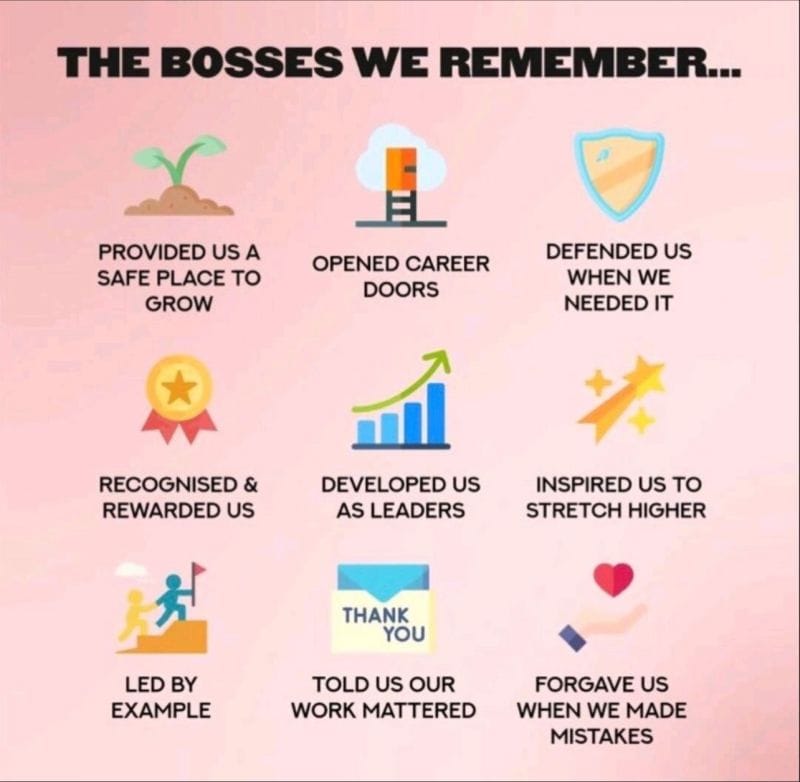
Team members are very loyal to their transformational leader, who they trust, admire, and respect. This belief in the leader, coupled with the leader’s aim towards improvement for the team, results in very motivated team members willing to perform out of the ordinary. See the image that describes a memorable, transformational leader.
Isn’t it funny that the image describing a good boss is actually sounding a lot like Jesus?
So what style of leadership did Jesus demonstrate?
We don’t need to look much further than
Matthew 9:10-17 where the Pharisee rebuke Jesus for eating with sinners, to which Jesus responds, "It is not the healthy who need a doctor, but the sick."
Jesus didn’t follow the usual hierarchy. He broke the mould of society at the time.
He was inclusive no matter what background or role or history the person had.
So clearly Jesus’ style was transformational.
But His transformation was not just of our way of thinking, but also of our hearts, spirit and very being.
Ezekiel 36:26 - “I will… give you a new heart and a desire to be faithful.”
Ezekiel 36:26-27 - “I’ll give you a new heart, put a new spirit in you. I’ll remove the stone heart from your body and replace it with a heart that’s God-willed, not self-willed. I’ll put my Spirit in you and make it possible for you to do what I tell you and live by my commands.”
C) CHRIST LEADS OUR INFLUENCE
Yesterday Ps Lakers presented us with a beautiful reflection on Matthew 5:8 and why having a pure heart gives us the privilege of seeing and knowing God more intimately.
The link to my talk today is that it’s this very same heart that will dictate the extent and impact of your influence.
Lead as an autocrat that influences by fear and your influence is limited to self-promotion and egotistical desires.
Lead like Jesus with a pure heart and influence with love and inclusion and you will be the leader that will be remembered. Your influence will be broader than you ever imagined.
With a pure heart this influence extends God’s Kingdom because it’s not for you. It’s to magnify God’s name, to exalt Him.
Jesus’ pure heart led to him dying on the cross for our sins and the saving of our very souls. What greater influence is there than that!
Therefore to truly lead effectively with real influence, we must first let God lead and guide us. The ultimate influencer must lead us first. If our heart is pure and we listen to God then every decision will influence in ways we can’t imagine. We must humble ourselves and let him take the helm.
John 3:30 (NIV) - "He must become greater; I must become less.”
This verse reminds us of how essential it is to put Jesus first. Over time, we serve our community the best when we allow more of Christ in our hearts and are less motivated by selfish endeavors and whims. A good leadership quality is to make sure that we are pointing those we lead back to Christ, rather than ourselves.
1 Timothy 4:8 - "For physical training is of some value, but godliness has value for all things, holding promise for both the present life and the life to come."
The best way to find success in life and to influence is to align our hearts and lives with Christ. This verse reminds us to seek godliness first as we navigate this life and prepare for the next one. When we seek godliness first, we ultimately are saying that God's will is greater and more important than our own selfish interests.
Join me in prayer.
D) WE START INFLUENCING NOW!
If you take anything away from today it’s this - that true influence comes from winning hearts. And to win hearts we need to have a pure heart. One that is humble and is led by God.
True influence = winning hearts through a pure heart that is directed by God.
But influencing is not passive. It’s not something we hope will happen if just get on and do things without direction. Influencing requires intentionality. We must want to influence and act to influence.
We must have the intention of changing the environment around us. Of changing the status quo. Of winning hearts.
It starts with every decision we make every day.
JP - Testimonial 1 – challenges before presenting to principals; attending GPN; letting God lead; led to influencing educators.
In this example I gave my heart to God and he guided me through a big challenge which led to influencing 40 senior educators.
JP - Testimonial 2 – WWE vs wife’s event. Where was my heart? When ego driven it was leading me down a dangerous path. With prayer and listening to God – realised I was making a mistake. The influence was on the example I gave my son and daughter and the message I gave my wife.
In this example I influenced my family through my heart which was guided by God.
Again, influence starts with every decision we make every day. Influence starts now. In our every day decisions. All our plans and ambitions. Led by God.
Gentlemen, ask yourselves:
- Will you let God guide you today?
- Who or what will you influence today?
- Ultimately, how and for what will you be remembered by your loved ones?
- What will be your legacy?
Let God guide your heart and your legacy today and going forward.
God bless!
Prayer Points:
Let’s pray – we thank you Jesus for the transformation You have bought into our minds, hearts and bodies. Thank you for the transformational and impactful influence You have had and will have in our lives and those of billions of others.
DOWNLOAD PDF

 :
: